Where does association stop and synaesthesia begin?
While listening to music, something often experienced in isolation (as with headphones on), it seems to me a natural reaction to imagine the video which should go with the song. When I saw American Beauty, I was very young, I don’t remember much more of the film than one scene in which a misfit boy is showing his girl a video he shot. There’s a polythene bag swirling around in a shifting whirlpool on the sidewalk. That’s all. That video was, for years, my definition of the ultimate in cinematography. It was like there was music coming out of it.
A few months ago, I had the good fortune of being able to watch the renowned Maria Pagés and her Flamenco troupe perform in New Delhi dance which was all at once of cobblestoned streets and the furnaces of hell. Maria Pagés dances to unfamiliar beats, I am a musician, but I could not keep time; the language is alien, I do not speak Spanish.
And yet as she danced, words were rushing out of my mouth; no, not words, formless ghosts burst out of me as if my soul would explode. The only form I knew to put them into was word. If I could recall what I thought (if you could call it that), faster than my own mind could process, at the time, I have no doubt that it would have produced some of the best I have ever written.
Beethoven’s Moonlight Sonata always conjures up in my mind the image of afternoon sun coming in through a window. Nothing to do with moonlight at all, actually. I heard Chopin’s Waltz in A Minor for the first time recently, and that day I listened to it at least thirty times, again and again. To me it sounded like a man in a battered overcoat, in a grey scene, walking at times briskly, almost breaking into a run, and at times shuffling; always hugging himself tight, trying fruitlessly to keep the driving rain from running down his neck and onto his back. I asked my friend S, over the phone, to tell me what it looked like. “Looks like or sounds like?” he checked. But I knew what I meant. Anyhow, what he saw was totally different. It was a man arranging for a birthday party outdoors, in a garden. It’s strange to reconstruct what was described, phone conversations force one to colour them with one’s own perception. But there were sepia flashbacks in his picture. The music lends itself to flashback, going distinctly from minor sounds to major sounds and back. S saw it as a filmmaker would, a structured and bounded view. I saw it as a torturous road; I was like the wildlife cameraman, following my fellow, not knowing what he would see next. He saw children playing. He saw destitution. He saw despair. He saw survivors. But overall the scene was never released from the grey downpour.
Even the distinctions between minor and major chords or scales seems to be questionable. I can certainly feel the sadness of minor notes, but I really wonder what the average non-musical person hears and feels. I tried this with my roommate last year, she has no particular musical inclination except the intermittent interest that all teenagers must have. I played her Romanza on the piano (electric keyboard, actually) and asked her if she could see where the mood changed. She could, it’s a good piece to start out with, very easy to pinpoint the changes (I don’t know if these are what are called movements). Even so, a hundred per cent statistic on a one person test is not exactly a fair sample. I was not convinced.
I really don’t know where normal associations end and synaesthetic ones begin; isn’t, say, BLUE=COLD or RED=HOT? Or are even these associations culture-specific? When you’re decorating a room, you are advised to choose colour schemes wisely, appropriate to the feel of the room. You wouldn’t paint a nursery red, would you?
You feel happy when you see/hear something, sad when something else. But wait, that’s not a synthesis of senses at all. I can’t figure this out, though. Is seeing in the mind’s eye seeing?
Sometimes I feel like I’m cheating. Is it all in my head? Does synaesthesia even exist? Or is it because I have never felt the real thing that I am a sceptic?
It’s tough being a sceptic and also being creative and a romantic. And considering that every synaesthete’s experience may differ vastly in strength and nature from the next, it makes it even harder to explain.
Great. One more to add to the identity crises.

Strange Attactor
Benoit Mandelbrot, one of the first to conceive of the all-encompassing nature of Chaos theory, was an outsider in his discipline. Which discipline was that? He was an outsider in every field people tried to fit him. He was of what he called the rare nomads-by-choice who are in the end the ones called, in retrospect, pioneers.
I run into some people sometimes who can appreciate the awe that a tyro must inevitably feel when comfronted with the surreal implications of Chaos and its incredible omnipresence. Like Professor Dosch of Heidelberg whom I met last year. When I began to quote Mandelbrot, he nodded and nodded; of course I am by no means the first to be romanced by the poetry so latent in seeing patterns in everything, which is not really a bad description of the beginnings of Chaos; subjective as it may sound, I cannot put out of my mind the sneaking suspicion that maybe even this is not the end. Before Chaos, Newtonian mechanics and Euclidian geometry were the limits to imagination. Now these ideas are slowly becoming obsolete; they no longer define what is allowed, or even what is understood.
Who knows what inspiration is; the borders between art and art hold infinite possibilities. What you think, what you compose, what you see, what you hear are all initial conditions.
I discovered today yet another astonishing example of what the human mind can do. The Strange Attractor that this post is supposed to be about is not what a Physics man would imagine. I'm a student of Literature, after all. Surely I can use poetic license enough to use the words like what they meant before Chaos. I was strangely attracted to one man's work. In computing terms it is not, perhaps, the most intricate of piece of programming, but it is art in a strange way, like the fantastic landscapes of Lorenz's weatherless diagrams.
It's all here, in case you miss the link at the bottom:
This man, Lauri Gröhn, has created the software which I was so sure must exist, it is too small a world for there to be no one else like me who wished to hear the music that was so visible in the multicoloured generated fractals. Generative Art. It's the ultimate in synaesthetic technology, really. What the mind does by accident, this program does by design. It starts with a picture and ends with music.
It does come to mind that if a computer can do this, what use am I? but even for a musician, curiosity and amazement should surely overpower any misgivings. Generative Art is not compu-spew. Far from it. Gröhn says that the difficult part is to find a picture that will sound good.
This making music from a picture is like "inspiration" taken very very literally. I was influenced by Dali and Magritte is now I wrote Dali and Magritte. It's as close as we've got to the mind reading machine that I always thought was the end of all technology, the apex of scientific progress after which anything else would just be redundant.
Which way does it work, though? Does the music sound like we would like the picture to sound? Or is what we hear at the end what we allow ourselves to associate with the picture till we see it as its musical counterpart?
It sounds like an exaggeration even to me, all this praise. But Synaesthesia has long fascinated me, and to find this serendipitously was like learning, for the first time, that radioactive decay turns one element into another. The elemental is as fluid as anything else.
READ ALL ABOUT Lauri Gröhn's PROJECT HERE
[Untitled]
I was watching a kite as he desperately flapped his wings for a breath of warm air to lift him up; someone asked me why I was standing there. He escaped, and in that split second I knew, once again, nothing about him and his flights of futility, searching, anguish in his heart, for a whisper of the familiar truth.
"Metaphore, metaphore", they cried to him, and no avail.
***
Neruda wrote of love, war and the unreachable heights of Macchu Pichu. Dali painted compositions exquisite: never had a rose been so filled with latent potency, poisonously floating above a matte lanscape of clocks, cesspools and slow decay in a desert land. The man in the bowler hat stood still at that mysterious threshold, the murky sea roaring silently behind him, never spraying his suit, time never slowing enough to let that apple fall from its suspended place. Monet held the light in his hands, letting it fall by degrees on the grass, the trees, the sky. David stood alone, the sadness in his eyes invisible to anyone who could not see past his sinews. The spark from the Creation of Adam came and rent his heart to the very core. Cambell's soupcan said silently to him, "Metaphore, metaphore".
***
Massimo stood before his mirror and wondered. What was it that made him fall in love with these things? They were so different. No, disparate, he corrected. Dark eyes looked out from the glass but not at him. Everything was like everything else. But they were called by different names. What was this Surrealism? Even the sunset on the shingled beach off the chalk cliffs was surreal to him. What was this Renaissance? Was not everything ever created a re-naissance of something else, something older?
These categories defeated him. He did not know what to do. When he wrote prose, it came out in iambs and turned into poetry. When he wrote poetry, it emerged in long, torturous lines which coalesced spontaneously into paragraphs and indented the first in every one.
Massimo scratched the front of his old jeans. He loved that sound, the feeling of that friction under his nails. The ginger cat came and went yet again, always returning in its constant emaciatedness to remind him - you eat, I get nothing. You make money, I get nothing. You are educated, you have access to Art, Culture, Music. I have nothing.
The cat was everything that was wrong with the world. Gripped by the old, inexorable guilt every time he saw the cat, he shut it out of sight but could not shut it out of his mind. He grimaced at the automatic pun that hit him. Maybe he was out of his mind. After all, he just realised that his sneaking suspicion had been confirmed, yet again. This cat was no ordinary cat. "Metaphore, metaphore", it called out to him in his language.
Schrödinger kicked in his grave. Any moment now, thought Massimo, I will realise that all the things in the world I had not attributed to Schrödinger's ephemeral cat also came from nowhere else, and will also conglomerate into one hideous heterogeneous ball of energy, only to Big Bang into the Second Law of Thermodynamics, which is really the First Law of Everything: "Entropy Increaseth".
Massimo looked down at the newspaper which had carried his first review. "Postmodern" was there even in the title. That word irked him no end. It had been a year since that review and he had not been able to shoot himself. The gun lay in the drawer silently, as before. To shoot himself, he reflected, was to make too strong a statement. His grave, he continued to reflect, should carry an epitaph - monument. A single epigram would not do for his epitaph. How would he explain all his multiplicity of contents?
In a flash, the gun was out, two sharp reports were heard, and Massimo's brains were found spattered all over the Edwardian furniture, Warhol reproductions and his own prosetry.
His epitaph has one line on it: "And all for want of a horseshoe nail".
The cat lies buried at his feet, conquered.
Conquered? Massimo's life is over. The cat has nine to go.
***
Neruda wrote of love, war and the unreachable heights of Macchu Pichu.
 Dali painted compositions exquisite: never had a rose been so filled with latent potency, poisonously floating above a matte lanscape of clocks, cesspools and slow decay in a desert land. The man in the bowler hat stood still at that mysterious threshold, the murky sea roaring silently behind him, never spraying his suit, time never slowing enough to let that apple fall from its suspended place. Monet held the light in his hands, letting it fall by degrees on the grass, the trees, the sky. David stood alone, the sadness in his eyes invisible to anyone who could not see past his sinews. The spark from the Creation of Adam came and rent his heart to the very core. Cambell's soupcan said silently to him, "Metaphore, metaphore".
***
Massimo stood before his mirror and wondered. What was it that made him fall in love with these things? They were so different. No, disparate, he corrected. Dark eyes looked out from the glass but not at him. Everything was like everything else. But they were called by different names. What was this Surrealism? Even the sunset on the shingled beach off the chalk cliffs was surreal to him. What was this Renaissance? Was not everything ever created a re-naissance of something else, something older?
These categories defeated him. He did not know what to do. When he wrote prose, it came out in iambs and turned into poetry. When he wrote poetry, it emerged in long, torturous lines which coalesced spontaneously into paragraphs and indented the first in every one.
Massimo scratched the front of his old jeans. He loved that sound, the feeling of that friction under his nails. The ginger cat came and went yet again, always returning in its constant emaciatedness to remind him - you eat, I get nothing. You make money, I get nothing. You are educated, you have access to Art, Culture, Music. I have nothing.
The cat was everything that was wrong with the world. Gripped by the old, inexorable guilt every time he saw the cat, he shut it out of sight but could not shut it out of his mind. He grimaced at the automatic pun that hit him. Maybe he was out of his mind. After all, he just realised that his sneaking suspicion had been confirmed, yet again. This cat was no ordinary cat. "Metaphore, metaphore", it called out to him in his language.
Schrödinger kicked in his grave. Any moment now, thought Massimo, I will realise that all the things in the world I had not attributed to Schrödinger's ephemeral cat also came from nowhere else, and will also conglomerate into one hideous heterogeneous ball of energy, only to Big Bang into the Second Law of Thermodynamics, which is really the First Law of Everything: "Entropy Increaseth".
Massimo looked down at the newspaper which had carried his first review. "Postmodern" was there even in the title. That word irked him no end. It had been a year since that review and he had not been able to shoot himself. The gun lay in the drawer silently, as before. To shoot himself, he reflected, was to make too strong a statement. His grave, he continued to reflect, should carry an epitaph - monument. A single epigram would not do for his epitaph. How would he explain all his multiplicity of contents?
In a flash, the gun was out, two sharp reports were heard, and Massimo's brains were found spattered all over the Edwardian furniture, Warhol reproductions and his own prosetry.
His epitaph has one line on it: "And all for want of a horseshoe nail".
The cat lies buried at his feet, conquered.
Conquered? Massimo's life is over. The cat has nine to go.
Foucault's Pendulum
Why exactly I wrote this I have forgotten, it's been a few months since I finished reading Umberto Eco's Foucault's Pendulum. But it really hits you, the novel, despite the multitude of references, cross-references, obscurities. The plot is brilliant, as is the Plan. Terrifyingly so. It's a scary book, especially if you are like me, and like your regular little dose of fiction. If you must read it, go ahead. But I really don't know if it's worth the trouble with the Templars, the Rosicrusians and the workings of Garamond. The milieu is just as specific as the plot is universal.
Incidentally, I picked up this book because the title had been eyeing me (not, I don't mean it the other way round. Haven't you ever felt a book or painting or song follow you?). As it turned out, Foucault was not, as I had imagined, Michel Foucault, but Léon Foucault. So fortuitous incidents sometimes backfire. So much for instinctively buying a book. Instinct was so awry this time that I bought it at Midland [South Extension-I, New Delhi. Opposite the bhelpuri-juice wala], one of my preferred bookstores (they always have a discount on pretty much everything in the shop) for just over 200 bucks, only to find the same edition, no less pirated-looking, in Daryaganj [Sunday pavement book bazaar in Old Delhi.] for 60 a few weeks later.
He's like Belbo. Abulafia was his own child. His child took over his mind. Aglie and all the rest, the taxidermist Salon, everyone - they're all Abulafia's children, descendents of his own mind. If they hadn't killed him he would have killed himself. Hell, he is killing himself, by spawning all these little incubated creatures.
The Plan's going to kill him. Amparo's left. She couldn't come to terms with her own feelings. She didn't know whether she belonged or she didn't. No one handed her an agogo. What had happened was her own personal problem. That's why I left. I had to deal with things on my own. If he kills himself, I can't do anything from here anyway.
If even the Thing couldn't keep him, what's the use of this thing I thought we had made together.
I am everyone. Amparo, confused; the Diabolicals, convinced; Casaubon, incomplete; Diatollevi, dying, spewing shit even then, Lia. Lia, Lia. Shining like an inelegant wet-nurse.
Jesus.
I think I just might go buy The Name of the Rose as well. The thing is, if it's not so important to remember detail, this book is remember-ed and -able.
Mind F*** of a novel.
There's that thing written on my wall in my ex-room in the hostel:
Universality is a function of ignorance.
When you know only a few chords, every song sounds like the last.
Incidentally, I picked up this book because the title had been eyeing me (not, I don't mean it the other way round. Haven't you ever felt a book or painting or song follow you?). As it turned out, Foucault was not, as I had imagined, Michel Foucault, but Léon Foucault. So fortuitous incidents sometimes backfire. So much for instinctively buying a book. Instinct was so awry this time that I bought it at Midland [South Extension-I, New Delhi. Opposite the bhelpuri-juice wala], one of my preferred bookstores (they always have a discount on pretty much everything in the shop) for just over 200 bucks, only to find the same edition, no less pirated-looking, in Daryaganj [Sunday pavement book bazaar in Old Delhi.] for 60 a few weeks later.
He's like Belbo. Abulafia was his own child. His child took over his mind. Aglie and all the rest, the taxidermist Salon, everyone - they're all Abulafia's children, descendents of his own mind. If they hadn't killed him he would have killed himself. Hell, he is killing himself, by spawning all these little incubated creatures.
The Plan's going to kill him. Amparo's left. She couldn't come to terms with her own feelings. She didn't know whether she belonged or she didn't. No one handed her an agogo. What had happened was her own personal problem. That's why I left. I had to deal with things on my own. If he kills himself, I can't do anything from here anyway.
If even the Thing couldn't keep him, what's the use of this thing I thought we had made together.
I am everyone. Amparo, confused; the Diabolicals, convinced; Casaubon, incomplete; Diatollevi, dying, spewing shit even then, Lia. Lia, Lia. Shining like an inelegant wet-nurse.
Jesus.
I think I just might go buy The Name of the Rose as well. The thing is, if it's not so important to remember detail, this book is remember-ed and -able.
Mind F*** of a novel.
There's that thing written on my wall in my ex-room in the hostel:
Universality is a function of ignorance.
When you know only a few chords, every song sounds like the last.
طعم گيلاس
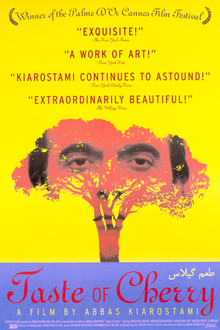 I just saw a Persian movie, Abbas Kiarostami's award winning Taste of Cherry (1997) (Ta'm-e gīlās or طعم گيلاس) today.
The first time I heard of him was recently, some time last year. I was at a huge bookfair at Pragati Maidan (one of the largest exhibition grounds) in New Delhi; I can't remember what section I was in, but there were a lot of books there of the type you would find in the Humanities sections in University libraries; non-fiction, stuff on identity and politics, etc. I don't know now what book it was that I opened, but I remember opening a page at random, and it was one of those glossy section-separator pages done in grey. It said
Inside the shrineI took it down immediately, somehow I knew I had to run into this poet again. His name was Abbas Kiarostami, and I had no idea he was also a photographer and filmmaker.
I thought a thousand thoughts
And when I left
it had snowed
 Later I Googled him, and found an old news clip from 2005; a series of his photographs, entitled Trees in Snow was on display April to June at the Victoria & Albert Museum and the Zelda Cheatle Gallery. (I think they were also shown at Berkeley in 2007). This little verse introduced the exhibit.
You can't figure out in the first maybe twenty minutes why Mr. Badii, a middle-aged Iranian (played by Homayoun Ershadi) is driving around the bleak desert outskirts of Tehran in his Range Rover. As it turns out, he is looking for help. He has decided to kill himself that night, and wants someone to come at daybreak the next day to the grave he has already dug, and after checking that he is dead, cover him with earth. After which there will be cash waiting in the car as reward. The film traces his journey in search of someone to help him in what no man seems to be willing to do.
This is not really a spoiler, but if you are afraid of it being, please skip the rest!
Mr. Bagheri says,I had gone to kill myself
and came back
with mulberries
Was this supposed to be poetry? Who knows. But I wish I could understand Persian; there is a certain cadence to the screenplay that is bound to be missed in subtitle.
As far as the visual dimension of the film goes, I don't know what to say; it's not a stylised movie, it's pretty functional. There are none of the scenic scenes, as it were, that I am so fond of - those that want to make you take a still photograph of the milieu. It's very rough around the edges; but still there are scenes like the one where he goes to the Museum to see Mr. Bagheri, the taxidermist who agrees to carry out his plan. He's sitting outside the lab, framed in the window and against the backdrop of a fall into a valley that is the undulating city.
In the quarry where he sits down, dust swarms around him till he is lost inside the whirling opaque cloud. When he is lying in the grave, he looks up and sees the moon, there are the secret nighttime sounds of the desert, and the thunderous gusts sweep dirt into his face under the grey.
Overall, I did not care much for the very very slow pace of the first half or so. And as for Mr. Bagheri, perhaps his dialogues are a little pat, but his mulberry tale makes up for it. There is something about the movie that is the opposite of intense. As my mother observed, he didn't look like he was suicidal at all. Perhaps that's Kiarostami's style, but although I always root for subtlety, I didn't really feel more than a curiosity for this man's quest. It gets better by the end, but is nothing compared to the haiku-like conciseness of the verse that first introduced me, irresistibly, to Abbas Kiarostami.
"Remember"
This is one of the most haunting songs I ever heard; Harry Nilsson's (1941-94) Remember, which I heard on the unforgettable soundtrack of You've Got Mail, a movie I have seen so many times it's pointless keeping count anymore.
P and I have had dinner-time You've Got Mail quizzes, everyone else looking on with a mixture of disdain and amazement. It's the kind of look you'd imagine the archetypal geeky Star Trek fan in the USA getting.
I love this movie; it's such an beacon of hope for hopeless romantics like me!
Every time I see it, something new dawns on me. Like when I looked up this clip
on Youtube, I realised she was talking all along about River, a beautiful Joni Mitchell song from her album Blue, that Uncle David sent to me in the big bundle of CDs that he shipped me from Hawai'i last year. I had been singing River ever since I heard it for the first time I heard it, and it was great to find yet another cross-reference that I had missed before, when I hadn't been introduced to Joni Mitchell. There are lines in this movie that you just don't forget. Like The Fall:
on Youtube, I realised she was talking all along about River, a beautiful Joni Mitchell song from her album Blue, that Uncle David sent to me in the big bundle of CDs that he shipped me from Hawai'i last year. I had been singing River ever since I heard it for the first time I heard it, and it was great to find yet another cross-reference that I had missed before, when I hadn't been introduced to Joni Mitchell. There are lines in this movie that you just don't forget. Like The Fall:
Joe Fox: Don't you love New York in the Fall? It makes me want to buy school supplies. I would send you a bouquet of newly-sharpened pencils if I knew your name and address. On the other hand, this not knowing has its charms.Or The Bloomingdales Butterfly:
Kathleen Kelly: Once I read a story about a butterfly in the subway, and today I saw one. I couldn't believe it. It got on at 42nd and got off at 59th, where I assume it was going to Bloomindale's to buy a hat that will turn out to be a mistake. As almost all hats are.Another movie that's always stayed with me is City of Angels. I just can't help it; it has dialogues like
Even my Dad can't get over this bit! Then of course, there's Hemingway's Pear:Maggie: Why do you wear the same clothes all the time? Why won't you give me your phone number? Are you married?
Seth: No.
Maggie: Are you homeless?
Seth: No.
Maggie: Are you a drummer?
Seth: What's that like? What's it taste like? Describe it like Hemingway.Sigh. I think I'll cut it out now. I need to get a life!
Maggie: Well, it tastes like a pear. You don't know what a pear tastes like?
Seth: I don't know what a pear tastes like to you.
Maggie: Sweet, juicy, soft on your tongue, grainy like a sugary sand that dissolves in your mouth. How's that?
Rebecca and the Dargah
Last term we had a New Girl in the hostel. It's easy in a hostel of 300 to spot a newbie. She was tall, lanky and not pretty, but nice looking. Oh, and did I mention she was white?
Rebecca and I got talking because when I said Hi and she noticed I was reading George Orwell's Nineteen Eighty Four. She turned out to be a well read, fairly well travelled Tasmanian with a British father and passport, interesting to talk to. She was rather reserved, though. She was older than most of us and I think a little reticent to begin with; our strange accents and the small things which to us are so commonplace must have been scary to her - she couldn't leave the hostel for a week because the din of the traffic was too much for her
I had been telling her that I attend every music/theatre/anything performance I possibly can, and she seemed interested, so I said I would tell her the next time I found something worth attending. As it happens, I was making plans with P and G to go to Nizammudin (just outside the Dargah) to eat some sinfully delicious desi food, so Rebecca was asked if she would like to join us, and she said ok. Those two got tied up somewhere else, and in the end it was just Rebecca and me.
Now I love exploring, so even though it was around seven in the evening and I had never been to Hazrat Nizamuddin ka Dargah, I didn't have any qualms about going there alone, as it were, with her. But when we got there I think the multitudes of men in the narrow lane got to her a little. And well, she is white. People are bound to stare, to comment. Hell, in India (at least in Delhi, Lucknow) people would yell lecherous comments at a woman even if she were covered from head to toe in a burqa!
When we finally made it through the gali, at the end of which was, presumably, the dargah, but I was beginning to wonder how a largish building (I expected) could possibly be there (conveniently forgetting, of course, places like Kashi Vishwanath ka Mandir, the most famous temple in Varanasi, which is reached by winding up a torturous and filthy little alley). We crossed lots of tiny shops selling garlands and things, offerings that people buy there; we also crossed a very hippie looking fellow who seemed to have smoked his day's quota of pot (or something stronger, perhaps) just a minute ago, and could not help falling over himself.
There was a small enclosure to our left, just before the dargah, something like the aangan, or courtyard, of a house. There we were supposed to take off our shoes.
Later I kicked myself for not remembering; of course you had to take off your shoes, it's only a matter of common sense in India to know that 99 percent you will have to go in barefoot. I guess I was so used to it that it did not strike me as out of the blue to be asked to take my shoes off.
Anyway, Rebecca had not done her homework on India, apparently. It was winter, she was wearing jeans, boots, and under them hose, the kind with the continuous sock at the end. I was just thinking when I saw her expression, that her nylon leggings were going to have major ladders if she walked around in them. But then I realised that wasn't what was bothering her.
I was really taken aback by what she said: her doctor back in Australia had told her never walk barefoot in India, or else she would catch hookworm or ringworm or some worm. Now, with the blind faith of the tourist, she was absolutely positive she would get ringworm there. I had a tough time convincing her; in fact I don't think I managed to all.
The thing is, I wanted to go in, I wasn't about to ruin a new experience for the sake of white man's fear. I know how this sounds, I know I sound rabid, but I'm just being honest, I was genuinely amazed at how adamantly she refused to take her shoes off. Finally she said I should go in, and she would wait outside. Like hell I would let that happen. I wasn't about to desert her and walk off; it's ok, I live in Delhi, I can always come back later.
I just assumed that an educated, well read and travelled person (as I have said) who came to India out of choice for an exchange program, would be open minded. I suppose it isn't that simple. I wanted to try one last time; all along I had been trying to calm her down, telling her not to worry, that there were lots of people, but it was safe, she had a local with her, it's not so dirty, I wouldn't advise going into a loo without chappals, but this place would be fine, just see; ad infinitum. Because I didn't want her to feel scared, I wanted this to be an illuminating experience, not a harrowing one. Now all I said was, Look, you decide. Do you want to take the plunge or not?
She came in finally, in her leggings and all. Once we were inside, it was my turn to feel weird.
All along I thought, I'll be able to mingle, I can mingle anywhere. But inside, I felt like a stranger. I had not done my homework either. I realised I should have read up a little on the place before coming. There was a man reading out something in Urdu (it could have been Arabic or even Persian, for all I know). I don't know, maybe it was from the Quran Sharif, I had no idea. I only knew the Bollywood story: you go there, make a wish (ask for a mannat), tie the red thread on the grill.
In Hazrat Nizamuddin ka Dargah, I was just as much a foreigner as she was, and I knew just as little as she did about the place or the customs. The dargah in itself is supposed to be a secular shrine now (oxymoronic, isn't it?), a Come One Come All. But the entire atmosphere is Muslim, like most of Old Delhi and Old Lucknow tend to be, both architecture-wise and in demographics. I felt like a fish out of water, but not really because I am not a Muslim, but because I entered a non-believer. I didn't believe even in the thread-tying. It was just some banal desire for quaintness that prompted that. I am an outsider even in a Hindu temple, for the same reason. It has nothing to do with religion.
It's faith I'm talking about.
It's easy to label the white man, saying he's the Imperialist who thinks India is all snake charmers; who comes to India loaded with preconceived notions. But what was harder was to realise that
1. we are ourselves the most clueless of all: even the customs we do know about, or follow, we follow cretinously.
2. we probably have the most prejudices in our own heads, which is why they make an appearance whenever something is new or different. 3. we Indians are racist too (oh no, I'm not even getting started on Indians in Nigeria, where I lived before: a later post perhaps).
I still don't know what stand I should take; what is right, or if there even is a "right". Do I need to know anything about my own culture? What then is "my" culture? To learn how to speak Tamil well? To wear a bindi? To know how to cook rasam? To know that on Visu (the New Year) I was supposed to make a visukanni?
What is all this? Even if I know all this, Hazrat Nizamuddin ka Dargah would still be a mystery to me. Do I learn the Quranic verses my Muslim friends learnt at home when they were children? The bare minimum is that I speak Hindi. And it feels inexplicably good when people tell me I speak it like a Lucknavi. It's the only kind of Hindi I know!
I don't know how to belong. There are just so many things you want to belong to, how do you keep your identity from getting fractured? On second thought, why should it even be bad for identities to be fractured? Surely that means people can mix more easily, if they are less rigid, more fluid?
I went to Aliganj the other day, a colony in Lucknow. Ten years in this town and I felt like a tourist still. My world is a world cordoned off by "uppermiddleclassHinduTamilBrahminwomanoncelivedinAfrica" sensibilities. All these are parts of my identity. But that leaves out so much!
Is it always going to be No One vs Everyone? What if I neither want to be devoid of all identity, (the purest, most honest identity of all being the lack of it) nor a hideous pastiche of every culture, and become a living endlessly hyperlinked, cross-referenced Wikipedia page?
Where does that leave me?
Rebecca and I got talking because when I said Hi and she noticed I was reading George Orwell's Nineteen Eighty Four. She turned out to be a well read, fairly well travelled Tasmanian with a British father and passport, interesting to talk to. She was rather reserved, though. She was older than most of us and I think a little reticent to begin with; our strange accents and the small things which to us are so commonplace must have been scary to her - she couldn't leave the hostel for a week because the din of the traffic was too much for her
I had been telling her that I attend every music/theatre/anything performance I possibly can, and she seemed interested, so I said I would tell her the next time I found something worth attending. As it happens, I was making plans with P and G to go to Nizammudin (just outside the Dargah) to eat some sinfully delicious desi food, so Rebecca was asked if she would like to join us, and she said ok. Those two got tied up somewhere else, and in the end it was just Rebecca and me.
Now I love exploring, so even though it was around seven in the evening and I had never been to Hazrat Nizamuddin ka Dargah, I didn't have any qualms about going there alone, as it were, with her. But when we got there I think the multitudes of men in the narrow lane got to her a little. And well, she is white. People are bound to stare, to comment. Hell, in India (at least in Delhi, Lucknow) people would yell lecherous comments at a woman even if she were covered from head to toe in a burqa!
When we finally made it through the gali, at the end of which was, presumably, the dargah, but I was beginning to wonder how a largish building (I expected) could possibly be there (conveniently forgetting, of course, places like Kashi Vishwanath ka Mandir, the most famous temple in Varanasi, which is reached by winding up a torturous and filthy little alley). We crossed lots of tiny shops selling garlands and things, offerings that people buy there; we also crossed a very hippie looking fellow who seemed to have smoked his day's quota of pot (or something stronger, perhaps) just a minute ago, and could not help falling over himself.
There was a small enclosure to our left, just before the dargah, something like the aangan, or courtyard, of a house. There we were supposed to take off our shoes.
Later I kicked myself for not remembering; of course you had to take off your shoes, it's only a matter of common sense in India to know that 99 percent you will have to go in barefoot. I guess I was so used to it that it did not strike me as out of the blue to be asked to take my shoes off.
Anyway, Rebecca had not done her homework on India, apparently. It was winter, she was wearing jeans, boots, and under them hose, the kind with the continuous sock at the end. I was just thinking when I saw her expression, that her nylon leggings were going to have major ladders if she walked around in them. But then I realised that wasn't what was bothering her.
I was really taken aback by what she said: her doctor back in Australia had told her never walk barefoot in India, or else she would catch hookworm or ringworm or some worm. Now, with the blind faith of the tourist, she was absolutely positive she would get ringworm there. I had a tough time convincing her; in fact I don't think I managed to all.
The thing is, I wanted to go in, I wasn't about to ruin a new experience for the sake of white man's fear. I know how this sounds, I know I sound rabid, but I'm just being honest, I was genuinely amazed at how adamantly she refused to take her shoes off. Finally she said I should go in, and she would wait outside. Like hell I would let that happen. I wasn't about to desert her and walk off; it's ok, I live in Delhi, I can always come back later.
I just assumed that an educated, well read and travelled person (as I have said) who came to India out of choice for an exchange program, would be open minded. I suppose it isn't that simple. I wanted to try one last time; all along I had been trying to calm her down, telling her not to worry, that there were lots of people, but it was safe, she had a local with her, it's not so dirty, I wouldn't advise going into a loo without chappals, but this place would be fine, just see; ad infinitum. Because I didn't want her to feel scared, I wanted this to be an illuminating experience, not a harrowing one. Now all I said was, Look, you decide. Do you want to take the plunge or not?
She came in finally, in her leggings and all. Once we were inside, it was my turn to feel weird.
All along I thought, I'll be able to mingle, I can mingle anywhere. But inside, I felt like a stranger. I had not done my homework either. I realised I should have read up a little on the place before coming. There was a man reading out something in Urdu (it could have been Arabic or even Persian, for all I know). I don't know, maybe it was from the Quran Sharif, I had no idea. I only knew the Bollywood story: you go there, make a wish (ask for a mannat), tie the red thread on the grill.
In Hazrat Nizamuddin ka Dargah, I was just as much a foreigner as she was, and I knew just as little as she did about the place or the customs. The dargah in itself is supposed to be a secular shrine now (oxymoronic, isn't it?), a Come One Come All. But the entire atmosphere is Muslim, like most of Old Delhi and Old Lucknow tend to be, both architecture-wise and in demographics. I felt like a fish out of water, but not really because I am not a Muslim, but because I entered a non-believer. I didn't believe even in the thread-tying. It was just some banal desire for quaintness that prompted that. I am an outsider even in a Hindu temple, for the same reason. It has nothing to do with religion.
It's faith I'm talking about.
It's easy to label the white man, saying he's the Imperialist who thinks India is all snake charmers; who comes to India loaded with preconceived notions. But what was harder was to realise that
1. we are ourselves the most clueless of all: even the customs we do know about, or follow, we follow cretinously.
2. we probably have the most prejudices in our own heads, which is why they make an appearance whenever something is new or different. 3. we Indians are racist too (oh no, I'm not even getting started on Indians in Nigeria, where I lived before: a later post perhaps).
I still don't know what stand I should take; what is right, or if there even is a "right". Do I need to know anything about my own culture? What then is "my" culture? To learn how to speak Tamil well? To wear a bindi? To know how to cook rasam? To know that on Visu (the New Year) I was supposed to make a visukanni?
What is all this? Even if I know all this, Hazrat Nizamuddin ka Dargah would still be a mystery to me. Do I learn the Quranic verses my Muslim friends learnt at home when they were children? The bare minimum is that I speak Hindi. And it feels inexplicably good when people tell me I speak it like a Lucknavi. It's the only kind of Hindi I know!
I don't know how to belong. There are just so many things you want to belong to, how do you keep your identity from getting fractured? On second thought, why should it even be bad for identities to be fractured? Surely that means people can mix more easily, if they are less rigid, more fluid?
I went to Aliganj the other day, a colony in Lucknow. Ten years in this town and I felt like a tourist still. My world is a world cordoned off by "uppermiddleclassHinduTamilBrahminwomanoncelivedinAfrica" sensibilities. All these are parts of my identity. But that leaves out so much!
Is it always going to be No One vs Everyone? What if I neither want to be devoid of all identity, (the purest, most honest identity of all being the lack of it) nor a hideous pastiche of every culture, and become a living endlessly hyperlinked, cross-referenced Wikipedia page?
Where does that leave me?
Subscribe to:
Posts (Atom)