Where does association stop and synaesthesia begin?
While listening to music, something often experienced in isolation (as with headphones on), it seems to me a natural reaction to imagine the video which should go with the song. When I saw American Beauty, I was very young, I don’t remember much more of the film than one scene in which a misfit boy is showing his girl a video he shot. There’s a polythene bag swirling around in a shifting whirlpool on the sidewalk. That’s all. That video was, for years, my definition of the ultimate in cinematography. It was like there was music coming out of it.
A few months ago, I had the good fortune of being able to watch the renowned Maria Pagés and her Flamenco troupe perform in New Delhi dance which was all at once of cobblestoned streets and the furnaces of hell. Maria Pagés dances to unfamiliar beats, I am a musician, but I could not keep time; the language is alien, I do not speak Spanish.
And yet as she danced, words were rushing out of my mouth; no, not words, formless ghosts burst out of me as if my soul would explode. The only form I knew to put them into was word. If I could recall what I thought (if you could call it that), faster than my own mind could process, at the time, I have no doubt that it would have produced some of the best I have ever written.
Beethoven’s Moonlight Sonata always conjures up in my mind the image of afternoon sun coming in through a window. Nothing to do with moonlight at all, actually. I heard Chopin’s Waltz in A Minor for the first time recently, and that day I listened to it at least thirty times, again and again. To me it sounded like a man in a battered overcoat, in a grey scene, walking at times briskly, almost breaking into a run, and at times shuffling; always hugging himself tight, trying fruitlessly to keep the driving rain from running down his neck and onto his back. I asked my friend S, over the phone, to tell me what it looked like. “Looks like or sounds like?” he checked. But I knew what I meant. Anyhow, what he saw was totally different. It was a man arranging for a birthday party outdoors, in a garden. It’s strange to reconstruct what was described, phone conversations force one to colour them with one’s own perception. But there were sepia flashbacks in his picture. The music lends itself to flashback, going distinctly from minor sounds to major sounds and back. S saw it as a filmmaker would, a structured and bounded view. I saw it as a torturous road; I was like the wildlife cameraman, following my fellow, not knowing what he would see next. He saw children playing. He saw destitution. He saw despair. He saw survivors. But overall the scene was never released from the grey downpour.
Even the distinctions between minor and major chords or scales seems to be questionable. I can certainly feel the sadness of minor notes, but I really wonder what the average non-musical person hears and feels. I tried this with my roommate last year, she has no particular musical inclination except the intermittent interest that all teenagers must have. I played her Romanza on the piano (electric keyboard, actually) and asked her if she could see where the mood changed. She could, it’s a good piece to start out with, very easy to pinpoint the changes (I don’t know if these are what are called movements). Even so, a hundred per cent statistic on a one person test is not exactly a fair sample. I was not convinced.
I really don’t know where normal associations end and synaesthetic ones begin; isn’t, say, BLUE=COLD or RED=HOT? Or are even these associations culture-specific? When you’re decorating a room, you are advised to choose colour schemes wisely, appropriate to the feel of the room. You wouldn’t paint a nursery red, would you?
You feel happy when you see/hear something, sad when something else. But wait, that’s not a synthesis of senses at all. I can’t figure this out, though. Is seeing in the mind’s eye seeing?
Sometimes I feel like I’m cheating. Is it all in my head? Does synaesthesia even exist? Or is it because I have never felt the real thing that I am a sceptic?
It’s tough being a sceptic and also being creative and a romantic. And considering that every synaesthete’s experience may differ vastly in strength and nature from the next, it makes it even harder to explain.
Great. One more to add to the identity crises.
Showing posts with label movie. Show all posts
Showing posts with label movie. Show all posts

طعم گيلاس
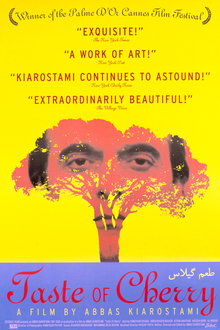 I just saw a Persian movie, Abbas Kiarostami's award winning Taste of Cherry (1997) (Ta'm-e gīlās or طعم گيلاس) today.
The first time I heard of him was recently, some time last year. I was at a huge bookfair at Pragati Maidan (one of the largest exhibition grounds) in New Delhi; I can't remember what section I was in, but there were a lot of books there of the type you would find in the Humanities sections in University libraries; non-fiction, stuff on identity and politics, etc. I don't know now what book it was that I opened, but I remember opening a page at random, and it was one of those glossy section-separator pages done in grey. It said
Inside the shrineI took it down immediately, somehow I knew I had to run into this poet again. His name was Abbas Kiarostami, and I had no idea he was also a photographer and filmmaker.
I thought a thousand thoughts
And when I left
it had snowed
 Later I Googled him, and found an old news clip from 2005; a series of his photographs, entitled Trees in Snow was on display April to June at the Victoria & Albert Museum and the Zelda Cheatle Gallery. (I think they were also shown at Berkeley in 2007). This little verse introduced the exhibit.
You can't figure out in the first maybe twenty minutes why Mr. Badii, a middle-aged Iranian (played by Homayoun Ershadi) is driving around the bleak desert outskirts of Tehran in his Range Rover. As it turns out, he is looking for help. He has decided to kill himself that night, and wants someone to come at daybreak the next day to the grave he has already dug, and after checking that he is dead, cover him with earth. After which there will be cash waiting in the car as reward. The film traces his journey in search of someone to help him in what no man seems to be willing to do.
This is not really a spoiler, but if you are afraid of it being, please skip the rest!
Mr. Bagheri says,I had gone to kill myself
and came back
with mulberries
Was this supposed to be poetry? Who knows. But I wish I could understand Persian; there is a certain cadence to the screenplay that is bound to be missed in subtitle.
As far as the visual dimension of the film goes, I don't know what to say; it's not a stylised movie, it's pretty functional. There are none of the scenic scenes, as it were, that I am so fond of - those that want to make you take a still photograph of the milieu. It's very rough around the edges; but still there are scenes like the one where he goes to the Museum to see Mr. Bagheri, the taxidermist who agrees to carry out his plan. He's sitting outside the lab, framed in the window and against the backdrop of a fall into a valley that is the undulating city.
In the quarry where he sits down, dust swarms around him till he is lost inside the whirling opaque cloud. When he is lying in the grave, he looks up and sees the moon, there are the secret nighttime sounds of the desert, and the thunderous gusts sweep dirt into his face under the grey.
Overall, I did not care much for the very very slow pace of the first half or so. And as for Mr. Bagheri, perhaps his dialogues are a little pat, but his mulberry tale makes up for it. There is something about the movie that is the opposite of intense. As my mother observed, he didn't look like he was suicidal at all. Perhaps that's Kiarostami's style, but although I always root for subtlety, I didn't really feel more than a curiosity for this man's quest. It gets better by the end, but is nothing compared to the haiku-like conciseness of the verse that first introduced me, irresistibly, to Abbas Kiarostami.
"Remember"
This is one of the most haunting songs I ever heard; Harry Nilsson's (1941-94) Remember, which I heard on the unforgettable soundtrack of You've Got Mail, a movie I have seen so many times it's pointless keeping count anymore.
P and I have had dinner-time You've Got Mail quizzes, everyone else looking on with a mixture of disdain and amazement. It's the kind of look you'd imagine the archetypal geeky Star Trek fan in the USA getting.
I love this movie; it's such an beacon of hope for hopeless romantics like me!
Every time I see it, something new dawns on me. Like when I looked up this clip
on Youtube, I realised she was talking all along about River, a beautiful Joni Mitchell song from her album Blue, that Uncle David sent to me in the big bundle of CDs that he shipped me from Hawai'i last year. I had been singing River ever since I heard it for the first time I heard it, and it was great to find yet another cross-reference that I had missed before, when I hadn't been introduced to Joni Mitchell. There are lines in this movie that you just don't forget. Like The Fall:
on Youtube, I realised she was talking all along about River, a beautiful Joni Mitchell song from her album Blue, that Uncle David sent to me in the big bundle of CDs that he shipped me from Hawai'i last year. I had been singing River ever since I heard it for the first time I heard it, and it was great to find yet another cross-reference that I had missed before, when I hadn't been introduced to Joni Mitchell. There are lines in this movie that you just don't forget. Like The Fall:
Joe Fox: Don't you love New York in the Fall? It makes me want to buy school supplies. I would send you a bouquet of newly-sharpened pencils if I knew your name and address. On the other hand, this not knowing has its charms.Or The Bloomingdales Butterfly:
Kathleen Kelly: Once I read a story about a butterfly in the subway, and today I saw one. I couldn't believe it. It got on at 42nd and got off at 59th, where I assume it was going to Bloomindale's to buy a hat that will turn out to be a mistake. As almost all hats are.Another movie that's always stayed with me is City of Angels. I just can't help it; it has dialogues like
Even my Dad can't get over this bit! Then of course, there's Hemingway's Pear:Maggie: Why do you wear the same clothes all the time? Why won't you give me your phone number? Are you married?
Seth: No.
Maggie: Are you homeless?
Seth: No.
Maggie: Are you a drummer?
Seth: What's that like? What's it taste like? Describe it like Hemingway.Sigh. I think I'll cut it out now. I need to get a life!
Maggie: Well, it tastes like a pear. You don't know what a pear tastes like?
Seth: I don't know what a pear tastes like to you.
Maggie: Sweet, juicy, soft on your tongue, grainy like a sugary sand that dissolves in your mouth. How's that?
Wong Kar Wai: The one that got left out
Last night I found on Youtube a couple of scenes which were deleted from the final release version of Wong Kar Wai’s In the Mood for Love. I felt a little cheated (no pun intended!) when I saw this bit.
The two of them are in the hotel room, wondering how "they" managed to make love; and them finally doing it themselves.
[This link is un-embeddable]
Some of the charm of this film lies in the fact that Su Li-zhen and Chow Mo-wan never really allow themselves to be "like them", like their unfaithful spouses. Their play-acting is endearingly sad, precisely because they never want to do anything more than pretend, rehearse. They have about them a formality which is highly stylised, like the entire film. Their pretences are ruled by a morbid curiosity which seems to arise from a troubled innocence.
No matter how I try to explain why their sleeping together was not hard for me to digest because of any moral considerations, I can hear the tone of disapproval in my own words. The decision to not do anything about the love that comsumes both of them is contradicted by their sleeping with each other. I think what I did not like about this idea is the lack of subtlety. It is a crude statement to hear her orgasmic gasps from the camera’s eye- view which peeps in from the outside of the hotel room window. It turns what is apparently a love born of great conflict and a shared hatred and sorrow, into something tawdry.
Even to me, even while writing this, it seems unfair to put such a premium on the love of these two being unrequited. Not unrequited in the conventional sense, but in the sense of, to put it more aptly, being unrequitable, and hence unrequited. Why, indeed, can’t they be like "them"? Surely the situation is different. Surely the circumstances under which their relationship began, and the reasons for which they love each other are not the same as those of their betrayers?
I’m reminded of the Harrison Ford movie Random Hearts (1999) in which he and Kristin Scott Thomas are in a similar situation, except that their spouses have died in a plane crash (which is why these two meet in the first place) and that the reasons (on her part, mostly) holding them apart are not quite the same as those in Wong Kar Wai’s film. In this case, the betrayers are dead, their affair was not known to anyone else, the survivors are in the green to hook up. But there is the guilt and the impropriety of beginning a relationship so soon after the tragedy, improper especially since Kay has an election campaign to run. It is the guilt that finishes them in the end, and the love that at least Butch still has for his late wife.
In both these movies, the couples choose not to pursue a love that would have made them both very happy, had it not been for the peculiar circumstances under which they had met or come to know each other.
In the Hollywood movie, however, the sex is not something you would even think twice about; perhaps it is some leftover Orientalist in me that wants to see the Asian couple as representing a love that is above the physical.
Somewhere I think the brooding nature of the general aesthetic of In the Mood for Love would have been ruined by a trial and error approach. If they were going to separate and decide not to be together anyway, what is the point of some frustrated lovemaking?
I really must see the film again; I started writing this on a whim and maybe it shouldn’t even be on the blog without more thought, but there you have it.
Who knows. Meanwhile, if I get so perturbed at one hint of sex, i run the risk of turning into a saffron-toting Shiv Seni, or worse, the deluded Jeff Bridges in The Mirror Has Two Faces!
When Richard Linklater met Milan Kundera
My best friend just got out of a four-odd year long relationship into which she had, as she does, poured her heart and soul, only to find that the guy she thought she loved had been lying to her all the time, not just about somebody else he was also seeing, but about tiny little inconsequential things, all of which added up to one big pile of white lies so tall that she had to quit, not being the kind who likes being with a compulsive liar.
She was talking to a friend on the phone the other day, and as phone conversations between interesting people so often do, this one was ending at five in the morning, and she observed that she could talk to her friend from sunrise to sunset (or sunset to sunrise, I’m just reconstructing roughly!), and then he cried, "Have you seen those movies?!"

She had not, in fact, seen Before Sunrise and Before Sunset (which by the way till I just looked them up on Wikipedia, even having seen both, I thought were called Before Sunrise and After Sunset,) so she got the CD of Before Sunset and saw it, not knowing it was the sequel. Anyway, I asked her how it was, and she didn’t like it. I asked why, and she said the man in the movie was obsessed with sex, and she thought that made the whole movie abusive.
Now, I’ve seen this movie once, about a year ago, and after watching the prequel, and I have no recollection of having made any such observation. In fact, I really liked the movie, and I thought it was a beautiful story, not incredibly original, but then people’s stories rarely are.
I told her maybe she should watch it again when she was happier! She’s not usually one for sop in movies (which is not always true about real life), while I, I think would die without the quantum of magic and coincidence in my life that I need, to keep me going.
I suppose her reaction to the movie just goes to show again, what I have suspected for a while; whatever is on your mind superimposes itself on what you do; Milan Kundera is right. I’m half-way through his The Unbearable Lightness of Being, and I know exactly what he means when he says Tereza would always be sentimental about Beethoven because he was playing on the radio when she first met Tomas, the man she would fall in love with, at the restaurant she worked at. "One cognac, please", Tomas’ order, and his first words to her, are not just his words then, they are a message.

Kundera writes,
[in Part Two: Soul and Body, Ch. 9, pg 48 of Harper Perennial Modern Classics edition]
[in Ch. 11, Pg 51]
It may not always sound so great, apparently; as my friend superimposed her anger and feeling of being betrayed onto the film, I remember the time I was watching Ido Tadmor on stage recently (April 2008). I was there by myself; I am so used now to finding no one to accompany me on my adventures in Delhi's cultural circuit that I don't even bother asking any more. I sat there in the hall, strangers all around me, not a familiar face in sight (unless you count Manish Arora whom I spotted there!) and it was as if he danced only for me, an art form that was formless, fluid, born of emotion, desire, experience, and not of a need for structure. Where there is no form, your mind can shape an experience into whatever it pleases, with or without your knowledge, whether you like it or not. I was sad that day; maybe sad is not the word, but I was mighty confused, and terribly lonely. The guard that we carry around with us is rarely let down easily; sometimes it is raised higher amongst strangers, sometimes we create strangers out of our friends. Maybe it's just me; but I know my voice changes in genteel company, I talk differently in different situations, and along with that manner of speaking comes a manner in general, I dress differently, I walk differently. I sat there in the auditorium with my guard up, a mile high, and feeling stiffly that this dance thing was going to be a damp squib. Then I looked around, still lonely, and seeing no one familiar or friendly around, I realized that since it didn't matter anyway what I did there that night (no one would recognize me) and there was anyway no one to whom I could confess that I was lonely, I might as well enjoy the show. So I tried, I really tried to grasp what was happening on stage; as it happens the opening song was not to my taste, but the next song was beautiful, his movements suddenly took on new meaning, the tune was a sad one, or so I thought. I'll never know, unless I hear that music again when I am happy. It was beautiful in the way an ancient building up in the mountains is. You feel a wrench, knowing its day of glory is passed and you can never see it in the form in which it was built, but that very sense of history and kahani [tale] behind it makes it the more beautiful. It a is a beauty tinged with sadness, like #20, Barakhamba Road.
I came out of the hall that day taking home with me an experience I will not forget soon; it was the beauty born out of the weight of my own soul, perhaps, that created that experience. I almost began to cry sitting there amongst strangers, not a familiar face in sight; I pulled myself together then, not seeing the point of a public catharsis. My guard went up again, and it could have been banal again, some new-age dancer, some arty-farty stuff; but no. It was beautiful even after I became myself, for in that brief moment I had lost myself to something outside of myself; little knowing that in reality, even what I saw was not merely what I saw, but what I read into what I saw.
She was talking to a friend on the phone the other day, and as phone conversations between interesting people so often do, this one was ending at five in the morning, and she observed that she could talk to her friend from sunrise to sunset (or sunset to sunrise, I’m just reconstructing roughly!), and then he cried, "Have you seen those movies?!"
She had not, in fact, seen Before Sunrise and Before Sunset (which by the way till I just looked them up on Wikipedia, even having seen both, I thought were called Before Sunrise and After Sunset,) so she got the CD of Before Sunset and saw it, not knowing it was the sequel. Anyway, I asked her how it was, and she didn’t like it. I asked why, and she said the man in the movie was obsessed with sex, and she thought that made the whole movie abusive.
Now, I’ve seen this movie once, about a year ago, and after watching the prequel, and I have no recollection of having made any such observation. In fact, I really liked the movie, and I thought it was a beautiful story, not incredibly original, but then people’s stories rarely are.
I told her maybe she should watch it again when she was happier! She’s not usually one for sop in movies (which is not always true about real life), while I, I think would die without the quantum of magic and coincidence in my life that I need, to keep me going.
I suppose her reaction to the movie just goes to show again, what I have suspected for a while; whatever is on your mind superimposes itself on what you do; Milan Kundera is right. I’m half-way through his The Unbearable Lightness of Being, and I know exactly what he means when he says Tereza would always be sentimental about Beethoven because he was playing on the radio when she first met Tomas, the man she would fall in love with, at the restaurant she worked at. "One cognac, please", Tomas’ order, and his first words to her, are not just his words then, they are a message.
Kundera writes,
[in Part Two: Soul and Body, Ch. 9, pg 48 of Harper Perennial Modern Classics edition]
" …Tomas [felt]…uneasy at the thought that his acquaintance with Tereza was the result of…improbable fortuities.
But is not an event in fact more significant and noteworthy the greater the number of fortuities necessary to bring it about?
"Chance and chance alone has a message for us. Everything that occurs out of necessity, everything expected, repeated day in and day out, is mute. Only chance can speak to us. We read its message much as gypsies read the images made by coffee grounds at the bottom of a cup.
[in Ch. 11, Pg 51]
"…If the seat Tomas occupied had been occupied instead by the local butcher, Tereza never would have noticed that the radio was playing Beethoven (though the meeting of Beethoven and the butcher would also have been an interesting coincidence). But her nascent love inflamed her sense of beauty, and she would never forget that music. Whenever she heard it, she would be touched. Everything going on around her at that moment would be haloed by the music and take on its beauty."
It may not always sound so great, apparently; as my friend superimposed her anger and feeling of being betrayed onto the film, I remember the time I was watching Ido Tadmor on stage recently (April 2008). I was there by myself; I am so used now to finding no one to accompany me on my adventures in Delhi's cultural circuit that I don't even bother asking any more. I sat there in the hall, strangers all around me, not a familiar face in sight (unless you count Manish Arora whom I spotted there!) and it was as if he danced only for me, an art form that was formless, fluid, born of emotion, desire, experience, and not of a need for structure. Where there is no form, your mind can shape an experience into whatever it pleases, with or without your knowledge, whether you like it or not. I was sad that day; maybe sad is not the word, but I was mighty confused, and terribly lonely. The guard that we carry around with us is rarely let down easily; sometimes it is raised higher amongst strangers, sometimes we create strangers out of our friends. Maybe it's just me; but I know my voice changes in genteel company, I talk differently in different situations, and along with that manner of speaking comes a manner in general, I dress differently, I walk differently. I sat there in the auditorium with my guard up, a mile high, and feeling stiffly that this dance thing was going to be a damp squib. Then I looked around, still lonely, and seeing no one familiar or friendly around, I realized that since it didn't matter anyway what I did there that night (no one would recognize me) and there was anyway no one to whom I could confess that I was lonely, I might as well enjoy the show. So I tried, I really tried to grasp what was happening on stage; as it happens the opening song was not to my taste, but the next song was beautiful, his movements suddenly took on new meaning, the tune was a sad one, or so I thought. I'll never know, unless I hear that music again when I am happy. It was beautiful in the way an ancient building up in the mountains is. You feel a wrench, knowing its day of glory is passed and you can never see it in the form in which it was built, but that very sense of history and kahani [tale] behind it makes it the more beautiful. It a is a beauty tinged with sadness, like #20, Barakhamba Road.
I came out of the hall that day taking home with me an experience I will not forget soon; it was the beauty born out of the weight of my own soul, perhaps, that created that experience. I almost began to cry sitting there amongst strangers, not a familiar face in sight; I pulled myself together then, not seeing the point of a public catharsis. My guard went up again, and it could have been banal again, some new-age dancer, some arty-farty stuff; but no. It was beautiful even after I became myself, for in that brief moment I had lost myself to something outside of myself; little knowing that in reality, even what I saw was not merely what I saw, but what I read into what I saw.
A Cultural Education: Delhi-Jan '07 to Apr '08
Theatre at Kamani Auditorium
presented by National School of Drama and Sanskar Rang Toli
Premchandki Kahaniyan: two day theatre festival of Premchand’s best
directed by Devendra Raj Ankur
2nd April, 2007
Music at India Habitat Centre
presented by The Delhi Music Society, Artsahimsa and the India International Centre
Laura Goldberg (Violin), Amy Lieberman (Soprano) and Steven Masi (Piano)
Bach, Beethoven and Debussy
followed by songs from The Great American Songbook (1935-1945)
Various vocal musics at M.L. Bhartia Auditorium, Alliance Française
presented by Alliance Française de Delhi and others
Delhi Chamber Choir and Delhi Opera Ensemble, conducted by Gabriella Boda-Rechner and Situ Singh Buehler
Debut concert of the Delhi Chamber Choir
Madrigals, motets, folk adaptations by Morley, Bach, Mozart, Mendelssohn, and Durufle; also operatic pieces by Delhi Opera Ensemble.
presented by Indira Gandhi National Centre for the Arts, Society for Promotion of Indian Classical Music and Culture Amongst Youth
Ziskakan, band from French Reunion Island comprising band members Gernard Clara, Mishko M'Ba, Pascal Manglou, Jean Rassiga, Rouben Savariaye
Band singing in native (French) Creole, to bass, guitar, tabla, drum, dholak, keyboards, conga, sitar and a special sea-sound instrument called creon.
Classical string quartet at Shri Ram Centre for the Arts
presented by Max Mueller Bhawan, Goethe-Institut, Society for Promotion of Indian Classical Music and Culture Amongst Youth
Music, Dance and demi-theatre at Max Mueller Bhawan
presented by The Neemrana Music Foundation and India International Centre
The Delhi Opera Ensemble led by Situ Singh Buehler, conducted by Gabriella Boda Rechner; also the Sadhya Ballet Troupe
Autumn Festival: two days of Classical music,
Second Day: Offenbach, Donizetti, Mozart, Puccini, Verdi
followed by songs from musical theatre, including J. Kander's (Life is a) Cabaret, J. Bock's If I Were a Rich Man from Fiddler on the Roof and Andrew Lloyd Webber's All I Ask of You from The Phantom of the Opera.
Music at Central Park, Connaught Place
presented by Seher, Indian Council for Cultural Relations, Ministry of External Affairs
SAARC Bands Festival
featuring Strings, Advaita, Soulmate and many more
Theatre orchestral music at Purana Qila
presented by Fondazione Cariparma, Commune di Parma, Fondazione Monte di Parma, Ministero degli Affari Easteri, Embassy of Italy Italian Cultural Institute, Indian Council for Cultural Relations, Delhi Tourism and others
Orchestra del Teatro Regio di Parma //(sorry if this link doesn’t work, it’s a Google-generated translation from the Italian) conducted by Donato Renzetti featuring Silvia Dalla Benetta (Soprano), Leonardo Lopez Linares (Baritone)
Verdi, Donizetti, Puccini, Rossini
c. 20th January, 2008
Film at India Habitat Centre
presented by Breakthrough, Federation of Film Societies of India, UHURU, India Habitat Centre, Alliance Française and others
Tri Continental Film Festival 08: Asia, Africa, America
India premiere of A Jihad for Love (2007), Arabic/ French/ Farsi/ Hindi/ Urdu/ Turkish film by Parvez Sharma, about sexuality in Islam.
c. 25th January, 2008
Theatre at Kamani Auditorium
presented by Dash Arts, The British Council, Indian Council for Cultural Relations and others
Tim Supple (Director)
A Midsummer Night's Dream, a multilingual English/ Tamil/ Malayalam/ Hindi/ Sinhalese/ Bengali/ Marathi/ Sanskrit acrobatic adaptation.
Music at India Habitat Centre
presented by Indian Council for Cultural Relations and others
Release of new album Public Issue by Sushmit Bose; Dylan-esque walkin'-talkin' ballads from the album; also two impromptu Baul songs
featuring vocals and rhythm guitar by Sushmit Bose, Deepak Castelino on banjo and classical guitar, backup vocals by Rukmini Sekhar
7th, 15th March, 2008
Music and Film at Alliance Française
presented by Organisation Internationale de la francophonie, Semaines de la Francophone India, Embassade de France en Inde, Alliance Française and others
Francophonie Weeks
7th March: Film Festival; Festival Vivre ensemble at M.L. Bhartia Auditorium
Zim and Co (2005) directed by Pierre Jolivet, about an ingenious young man dogged by trouble.
15th March: Alliance Française de Delhi Golden Jubilee Choir
17th, 19th March, 2008
Music at Max Mueller Bhawan and India Habitat Centre
presented by Indian Council for Cultural Relations, Goethe-Institut, Hungarian Information and Cultural Centre, Auswärtiges Amt, German Federal Foreign Office
Capital City Minstrels and the Remscheider Vokalensemble //(sorry if this link doesn’t work, it’s a Google-generated translation from the German)
conducted by Gabriella Boda-Rechner and Werner Rizzi
Viva la Musica - Songs Beyond Borders
Orlando di Lasso, Claudio Monteverdi, Thomas Morley, Johann Sebastian Bach, Felix Mendelssohn Bartholdy, Brahms, Max Reger, Gerhard Schwarz //(not found online!) , Johann K. Bachofen //(no info found online!), Fritz Werner and others, including Rizzi's own Wundernacht
also songs from India, Morocco, Venezuela, Hungary and Israel.
Eröd Iván's Viva la Musica as encore.
17th April, 2008
Dance at Stein Auditorium, India Habitat Centre
presented by Embassy of Israel
You: a choreography by Israeli dancer-choreographer Ido Tadmor
Featuring singer/dancer Michal Amdurski and pop musician Ohad Hitman
presented by Embajada de España en Delhi, Indian Council for Cultural Relations
La Compañía María Pagés
Ficció
This is on my favourites list since I saw it screened at the India Habitat Centre as part of the 13th European Union Film Festival, India 2008; a festival which lasted from 1st to 30th April and took some twenty-odd award-winning European cinema and documentary to New Delhi, Chennai, Kolkata, Kozhikode and Pune.
On Sunday, 6th, I watched It's Spring in Prague Every Year, a Czech documentary about musicians in a famous mega-concert hald in Prague every year; mostly behind-the-scenes drama, very interesting, and very real. Not to mention I was soaking in the movements of the conductors like a sponge, I have to do this soon enough with my music society!
Then I hung around for a while and realised there was another movie on, from Cyprus, called Honey and Wine, a weird tale of a mother who lost her son ages ago and leads a lonely and enlessly repititive life (the first ten minutes of the movie kill you, they run through three completely identical days) until she makes friends with this gorgeous young actress who lives across the road. They both find a shoulder, and the movie stays, if not very deep-rooted, in your mind as a bittersweet tale of people.

But the movie I really loved was a Spanish film called Ficció, or Fiction. Directed by Cesc Gay, it is the story of a filmmaker (Àlex) about to go over the hill, facing a mid-life crisis and making a movie about a man whose friends come over on his 39th birthday and sit around in the dark, talking. He is on a sabbatical, as it were, from fatherhood (there are two kids, one in a stroller) and his wife; on holiday in the mountains (the film is shot on location in Barcelona, Cataluña, Puigcerdá and Girona in Spain) with his friends, Santi and Judith, who have another friend, a charming violinist named Mònica. The four of them are roughly the same age, Àlex is as he is, Mònica is about to adopt a baby girl with her boyfriend. They all go trekking to the most breathtakingly beautiful lakes and then to higher mountains. Àlex and Mònica get lost in the mountains and talk, sitting on a flat high up in the clouds. They just talk, like the man in his movie might.
On Sunday, 6th, I watched It's Spring in Prague Every Year, a Czech documentary about musicians in a famous mega-concert hald in Prague every year; mostly behind-the-scenes drama, very interesting, and very real. Not to mention I was soaking in the movements of the conductors like a sponge, I have to do this soon enough with my music society!
Then I hung around for a while and realised there was another movie on, from Cyprus, called Honey and Wine, a weird tale of a mother who lost her son ages ago and leads a lonely and enlessly repititive life (the first ten minutes of the movie kill you, they run through three completely identical days) until she makes friends with this gorgeous young actress who lives across the road. They both find a shoulder, and the movie stays, if not very deep-rooted, in your mind as a bittersweet tale of people.
But the movie I really loved was a Spanish film called Ficció, or Fiction. Directed by Cesc Gay, it is the story of a filmmaker (Àlex) about to go over the hill, facing a mid-life crisis and making a movie about a man whose friends come over on his 39th birthday and sit around in the dark, talking. He is on a sabbatical, as it were, from fatherhood (there are two kids, one in a stroller) and his wife; on holiday in the mountains (the film is shot on location in Barcelona, Cataluña, Puigcerdá and Girona in Spain) with his friends, Santi and Judith, who have another friend, a charming violinist named Mònica. The four of them are roughly the same age, Àlex is as he is, Mònica is about to adopt a baby girl with her boyfriend. They all go trekking to the most breathtakingly beautiful lakes and then to higher mountains. Àlex and Mònica get lost in the mountains and talk, sitting on a flat high up in the clouds. They just talk, like the man in his movie might.
- This is a beautiful place to shoot a movie. - Why don't you? - [Shrugs] - What would happen in this movie of yours? - Nothing, he says. This. Two people get lost on a mountain and sit there. Talk.They get back and all, it's not a high-energy drama like Speed or Twister. They end up spending the day together a couple of days later; he gives her a lift to the clinic in town to get a cut treated; then they just hang around in the prettiest little town. It starts to rain at one point, they enter a pub that's close by; nothing happens - you're waiting - is he in love with her? He looks at her sometimes, with that look. She looks at him sometimes, with that look. Is she in love with him? Nothing happens. They have to part ways soon enough, Àlex's family joins him and Mònica has to leave. He gets up early the morning she has to leave, Judith and her girlfriend are giving her a ride. He catches them midway, he wants to say goodbye.
- I felt something. - I had a knot in my stomach. - I think we've fallen a little in love. - It's good...to fall in love sometimes. - I would have loved to... - I know, me too. But I'm just beginning to do things right. - Maybe I'll see you again.They kiss heartwrenchingly and that's that.
***
Ficció is a beautiful film - there are scenes which make you want to photograph them, there is music that drifts out from the radio in the kitchen and fills the valley with loneliness. There is a sadness in the dark, when the lights go out and Àlex is sitting by himself. When they are on their way back, by a circuitous route, they get a room somewhere, to rest awhile. There is a piano there, and chess. They start a chess game, both pros, but leave it for the piano, she plays with care, gently, pianissimo, dolce. When they are in the pub, nothing happens. She is smoking a cigarette, he is drinking from a short broad glass, maybe whisky. They are in background and foreground, not more than a foot apart, on the bar stools, so it looks like they are back to back. The focus shifts from one to the other, there is a knot in the stomach. Nothing happens. Are you comfortable? he asks again and again. There is more that is going on, Santi and Judith and subplot, but I couldn't get over that line.I think we've fallen a little in love. It's good...to fall in love sometimes.
Subscribe to:
Posts (Atom)